A-Level Physics: Moving from a B to an A* in 10 Weeks
- Joseph RB
- 1 day ago
- 6 min read
Updated: 3 hours ago
A B grade in A-Level Physics is not a ceiling — it is a starting point. The gap between a B and an A* is real and significant, but it is not primarily a gap in knowledge. Students who plateau at B typically know the physics. What they lack is precision in translating that knowledge into marks: the ability to write answers in the language the mark scheme rewards, and to make synoptic connections across topic areas in the way that harder questions demand.
Ten weeks of structured, targeted preparation — the length of our Foundation package at Sophyra Tutors — is enough time to close that gap, provided it is used strategically. This article sets out a realistic week-by-week plan, explains the mechanics of the B-to-A* jump, and is honest about when ten weeks is not sufficient.
What Separates an A* from a B in A-Level Physics
Before mapping out the weeks, it is worth being precise about where the marks are lost.
Mark-Scheme Precision
Physics examiners mark to a mark scheme, not to a general impression of correctness. A student who understands the concept of electric field strength but writes "the force on the charge" instead of "the force per unit positive charge" may lose the mark. This is not pedantry — it is the measurement of whether a student can communicate physics accurately. B-grade students frequently know the physics but write imprecisely.
Synoptic Thinking
A* questions — particularly in Paper 3 (or its equivalent, depending on specification) — draw on knowledge from multiple topic areas simultaneously. A question about a charged particle moving in a magnetic field may require mechanics, fields, and energy conservation in a single working. Students who have revised topics in isolation struggle with this integration.
Calculation Discipline
B-grade students sometimes lose marks in multi-step calculations not because they cannot do the physics but because they make substitution errors, use the wrong unit, or fail to define symbols before using them. These are recoverable errors with targeted practice.
Graph and Data Interpretation
Higher-tariff questions frequently present unfamiliar data or graphs. A-grade and A* students are comfortable extracting information from unfamiliar contexts and applying known physics to interpret it. This is a learnable skill, but it requires practice with varied question types.
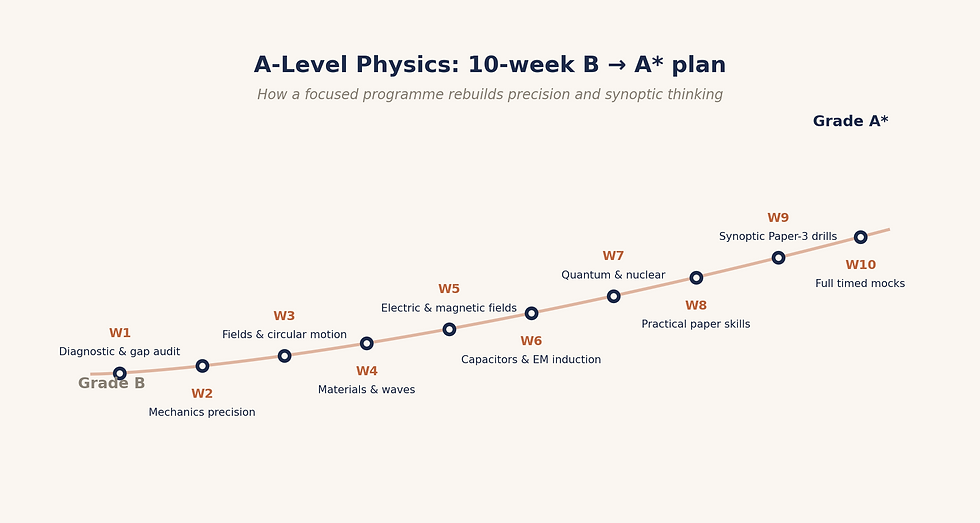
The 10-Week Plan
This plan maps directly to the structure of the Sophyra Tutors Foundation Package — ten focused weeks of 1:1 tuition designed around exactly this kind of targeted preparation. It assumes the student has completed their A-Level content and is moving into intensive revision mode.
Weeks 1–2: Mechanics and Materials
Mechanics is the most reliably tested topic across all major specifications (AQA, OCR A/B, Edexcel, CIE). It underpins many synoptic questions in later papers. Start here.
Focus areas:
Newton's laws, momentum, and impulse — particularly questions involving explosions, collisions, and rockets
Circular motion and simple harmonic motion — both appear regularly at A2
Energy conservation across different scenarios
Materials: stress, strain, Young's modulus, and the distinction between elastic and plastic deformation
Mark-scheme precision work: practice writing out each step of a calculation with defined quantities and units before substituting values. This is the habit that prevents careless errors in multi-step questions.
Weeks 3–4: Electricity and Circuits
Electric circuits — including Kirchhoff's laws, internal resistance, potential dividers, and the behaviour of real components — appear in every specification at considerable mark weighting. Errors here are typically algebraic rather than conceptual.
Focus areas:
Deriving and applying Kirchhoff's voltage and current laws
Internal resistance calculations, including graph interpretation (V against I)
Potential dividers and sensor circuits
Capacitance: charging and discharging, time constants, graphical analysis
Mark-scheme precision work: practise identifying what a graph's gradient and intercept represent *before* sketching it. Examiners frequently award marks for labelled axes, correct shape, and identified values — not the curve alone.
Weeks 5–6: Fields (Gravitational, Electric, Magnetic)
Fields questions are a common source of B-grade stumbling blocks because the three field types share mathematical structure but differ in important physical details. Students who revise them in sequence — rather than comparatively — often mix up conventions and equations.
Focus areas:
Gravitational fields: Newton's law of gravitation, field strength, potential, orbital mechanics
Electric fields: Coulomb's law, field patterns, potential — and the parallel to gravitational field maths
Magnetic fields: force on a moving charge and a current-carrying conductor, electromagnetic induction, Faraday's and Lenz's laws
Synoptic practice: attempt questions that combine two or more field types — charged particles in gravitational and electric fields simultaneously, for instance. These are hallmarks of A* questions.
Week 7: Quantum Physics and Particle Physics
Quantum topics — the photoelectric effect, electron diffraction, wave-particle duality — are conceptually distinct from classical mechanics and require a different mode of reasoning. Mark-scheme answers in this area are often more qualitative, demanding precise use of terminology.
Focus areas:
Photoelectric effect: the role of threshold frequency, work function, and Planck's equation
Wave-particle duality: de Broglie wavelength and its experimental evidence
Particle physics: quarks, leptons, and the conservation laws (baryon number, lepton number, charge, strangeness)
Precision work: in quantum questions, the word "photon" is not interchangeable with "light" or "radiation." Marks are awarded for specificity.
At the halfway point of a revision programme, a structured mock with expert feedback is invaluable. Book your Foundation 10-week package with Samra Ambreen to access exactly this — including paper-3 synoptic mocks with full mark-scheme review.
Week 8: Practical Skills and Paper 3 Preparation
Paper 3 (AQA) or its equivalent — the practical and synoptic paper — is where A* candidates separate themselves from A candidates. It cannot be revised by memorising content; it requires practising the *type* of thinking the questions demand.
Focus areas:
Identifying independent, dependent, and control variables in experimental descriptions
Uncertainty analysis: absolute uncertainty, percentage uncertainty, combining uncertainties in calculations
Evaluating experimental methods: sources of systematic and random error, suggested improvements
Synoptic questions: integrating mechanics, fields, electricity in unfamiliar contexts
Students who have not practised under timed conditions before Week 8 typically find the pace of Paper 3 challenging. Timing is a practical skill, not a cognitive one.
Weeks 9–10: Full Mocks and Targeted Gap Closure
The final two weeks follow a structured cycle: one full mock under exam conditions, analytical mark-scheme review, identification of remaining gaps, targeted topic return, and a second mock. This mirrors the approach described in our article on the 1:1 advantage in focused tuition.
The analytical review is more important than the mock itself. A student who completes four mocks without rigorous mark-scheme review learns less than one who completes two with thorough analysis of every missed mark.
It is also important to manage the cognitive load of this period carefully. Our article on academic results without the burnout addresses how to sustain performance across an intensive revision period without the quality of thinking declining.
When 10 Weeks Is Not Enough
It would be dishonest not to address this. Ten weeks of focused preparation is sufficient to move from a solid B to an A or A* for a student who:
Has completed the full A-Level curriculum
Has a reasonable understanding of the core topics across mechanics, electricity, and fields
Is in the final stretch of revision rather than starting from scratch
Ten weeks is not sufficient if:
The student has significant content gaps — whole topic areas that have not been taught or understood
The student is currently at a D or below, indicating that foundational conceptual work is required
The student is also managing other high-stakes subjects at HL or A-Level with equally intensive revision requirements
In these cases, a longer programme — beginning earlier in Year 13 or even in Year 12 — is more appropriate. A diagnostic session with a Physics tutor will identify which situation applies.
Full details of our Physics tuition, including the Foundation Package, are available on our Science service page and our student service page.
Ready to start your 10-week A* push? Book a free Physics consultation with Samra Ambreen at Sophyra Tutors and build a plan tailored to your specific exam board and current grade.
Frequently Asked Questions
**Is ten weeks enough time to go from a B to an A* in A-Level Physics?** For a student who has completed the curriculum and has a reasonable grasp of core content, ten weeks of targeted revision — focusing on mark-scheme precision and synoptic thinking — is typically sufficient. Students with larger content gaps may need longer.
Which A-Level Physics specification is the most demanding? All major specifications are calibrated to the same standard by Ofqual. The differences lie in how content is weighted and assessed. AQA's Paper 3 has a strong practical and synoptic focus; CIE includes an additional paper on Practical and Applications. The "hardest" specification varies by student.
Should a student focus on weaker topics or stronger ones in the final weeks? Both. The final mock phase should begin with a realistic whole-paper attempt, which gives a clear picture of where marks are being lost. Typically, a mix of reinforcing strong topics to their maximum potential and closing the most damaging gaps in weaker areas is most efficient.
**How many hours per week does a realistic A* revision programme require?** In our experience, fifteen to twenty hours of active study per week — including tuition sessions, independent practice, and mark-scheme review — is a productive amount. More hours with lower focus tend to produce diminishing returns.
**Can a student move from a B to an A* without a tutor?** Yes, in principle — provided they have access to past papers, mark schemes, and the discipline to use them analytically. The advantage of working with an expert tutor is the speed of gap identification and the quality of feedback on written answers; both of these are difficult to replicate independently.