
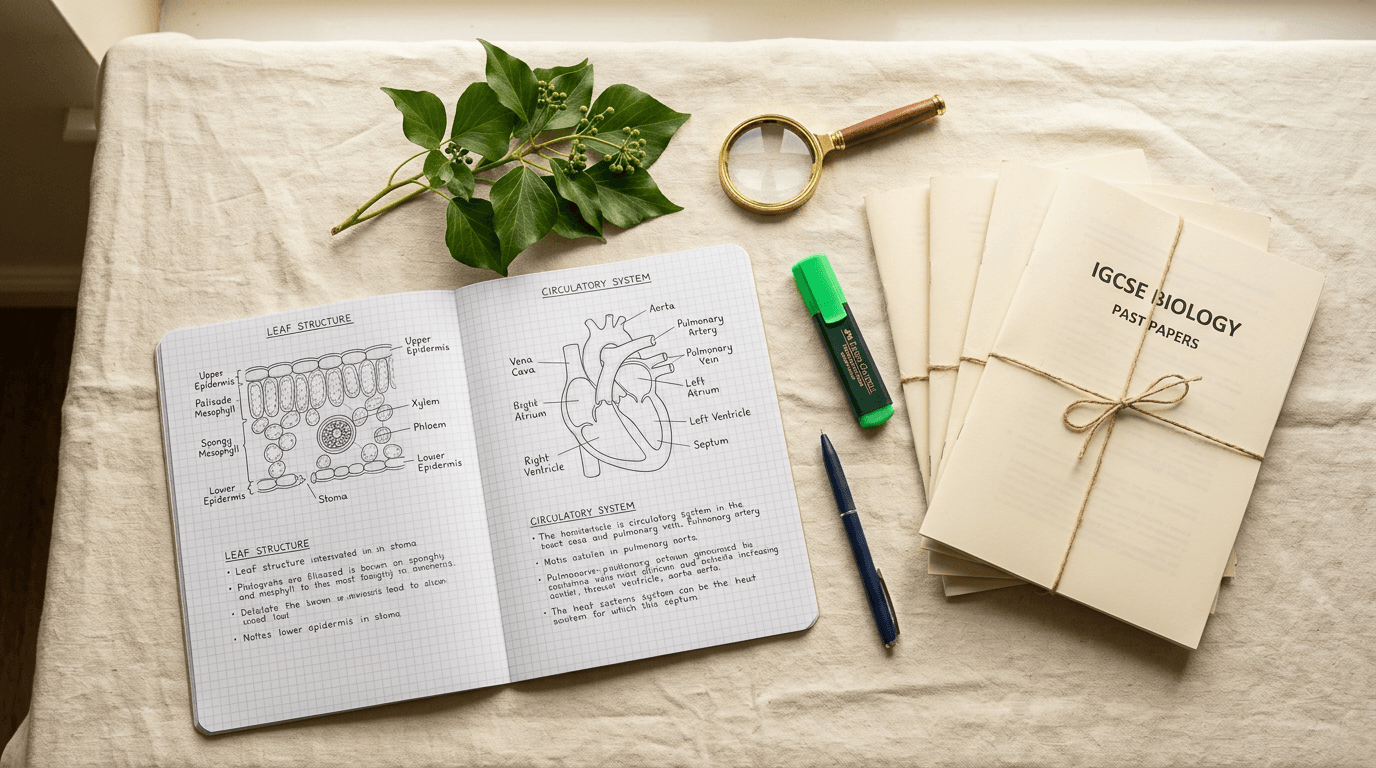
A completed Biology paper tells you more than a total mark. An omitted unit, a description where an explanation was needed, and a gap in subject knowledge each call for a different next step. Reviewing those differences makes the next practice session more useful.
The five-step cycle below is a suggested way to use a question, its mark scheme and a follow-up task together. Use papers from the student’s own specification and check any uncertainty with their teacher.
How to learn from a mark scheme
Using a mark scheme only to tick or cross an answer misses an opportunity. Read the permitted answers and marking instructions, then identify the difference between the response and what the question required.
Mark schemes are not written for students. They are written for examiners. They describe the acceptable range of answers for a question, often with "accept" alternatives and "reject" keywords. They reveal, if you read them carefully, what the examiner was looking for and why certain phrasings earn marks while others, even if scientifically accurate, do not.
After identifying a missed point, explain it in your own words and try a related question later. That follow-up helps you check whether the idea is understood, rather than whether the original answer has been remembered.
Reading a mark scheme analytically, rather than as a simple answer-checker, is the core skill this article develops.
Understanding IGCSE Biology command terms
Before we reach the five-step cycle, it is worth building a shared vocabulary. IGCSE Biology papers, particularly Cambridge International, use command words with precise meanings. Misreading a command word can leave a scientifically correct answer addressing the wrong task.
Define
Requires a formal biological definition. "Define diffusion" requires: the net movement of particles from a region of higher concentration to a region of lower concentration, down a concentration gradient. Every clause in that definition may be a mark point. Paraphrasing imprecisely ("when things move from where there's more to where there's less") typically earns no marks.
Describe
Requires factual statements about what happens, not why it happens. "Describe the changes during inspiration" requires a list of events (diaphragm contracts, moves down; intercostal muscles contract; thoracic volume increases; etc.) without necessarily explaining the mechanism.
Explain
Requires the reason for what is observed. This is where students most often lose marks by drifting back into description. "Explain why inspiration occurs" requires reference to the pressure change that results from the volume increase. The mechanism must be stated.
Suggest
Requires applying biological knowledge to an unfamiliar context. There may be more than one acceptable answer. Examiners award marks for biologically sound reasoning, even if it differs from the mark-scheme example. Students who read "suggest" as "I don't know the answer" miss the point. It is an invitation to apply principles.
Calculate
Show working at every step. Method marks are available even if the final answer is incorrect. Do not round intermediate figures prematurely, and include units in the final answer.
The five-step past-paper cycle
Use the cycle with the exact qualification and paper the student is taking. Cambridge International and Pearson Edexcel publish their own materials, and their content and assessment structures should not be treated as interchangeable.
Step 1: Attempt under timed conditions
Attempt the paper, or a defined set of questions, under exam conditions. No notes, no mark scheme, strict timing. This is the only step in which you are testing yourself; all subsequent steps are learning.
Do not skip this step or complete it with access to revision materials. The diagnostic value of Step 1 depends entirely on whether it reflects genuine exam conditions.
Step 2: Mark against the mark scheme, analytically
Now open the mark scheme. For each question:
- If you earned the mark: identify why, what specific phrasing or content was correct?
- If you missed the mark: identify exactly where your answer diverged from the mark-scheme language. Was it a missing clause? A wrong keyword? A description where an explanation was needed?
Write brief notes next to each question. This analytical review is the most important step in the cycle and should take at least as long as the attempt itself.
Step 3: Identify the command-word error
For every missed mark, check whether the question was understood. A command-word error is one possibility; missing knowledge, imprecise language, calculation mistakes and incomplete use of the data are others.
Categorise your errors into two types: knowledge gaps (I did not know this) and technique errors (I knew it but misread the question or wrote an incomplete answer). This distinction matters because the revision strategies for each type are different.
Step 4: Revisit the underlying content
For knowledge gaps, return to the relevant section of your notes or textbook. Do not simply re-read. Write out the key points from memory after reviewing them, then check what you missed. The Education Endowment Foundation's review of cognitive science finds that retrieving information from memory in this way is often a better strategy for learning than restudying the same material.
For technique errors, practise writing model answers using the mark-scheme phrasing as a template. Understand why the examiner's phrasing earns the mark rather than memorising it verbatim; you will rarely encounter identical wording in an actual exam.
Step 5: Track patterns across papers
After completing three or more past papers using this cycle, review your error logs. Which topics appear in your knowledge-gap category repeatedly? Which command words do you consistently misread?
This pattern recognition transforms individual paper reviews into a structured revision plan. You stop allocating time proportionally to content volume and start allocating it proportionally to your actual weaknesses.
A Biology tutor can work through this cycle with the student, identifying the patterns that are hardest to spot alone. Book a free IGCSE Biology consultation.
Recurring exam patterns in IGCSE Biology
The topics below are examples for practice, not a prediction of the next paper or a ranking by frequency. Check the full syllabus and read each question before deciding how to answer.
Photosynthesis and respiration
Photosynthesis and respiration can be practised through recall, data interpretation and experimental questions. Begin by checking that the student can distinguish the processes and explain what is happening in the context given.
Inheritance and genetic crosses
For the genetics content required by the specification, practise defining symbols, setting out crosses and interpreting probabilities. Keep each step visible so an error can be traced.
Transport systems (circulatory and transpiration)
For transport questions, connect structure with function. Explaining how a capillary wall affects diffusion requires a relationship, not just a description of the wall.
Homeostasis
Check which homeostasis examples the syllabus requires. When explaining a response, identify the change, the response and its effect, using the detail appropriate to the question.
Using feedback from a teacher or tutor
Some answers are difficult to mark alone. Take the question, your working and the mark scheme to a teacher or tutor. Ask which part needs correction and what a useful follow-up question would be.
Our article on building students' confidence through tutoring explores how this kind of structured, targeted feedback supports not just performance but self-belief, which matters especially in the pressure of exam season.
Details of our IGCSE Biology tuition are on our GCSE and IGCSE Sciences page.
Common student errors in IGCSE Biology exams
Use this checklist when reviewing an answer:
- Writing "increases" or "decreases" without specifying what increases or decreases relative to what.
- Describing correlations in graphs as causation without qualification.
- Omitting units from calculation answers.
- Writing vague statements ("the cell becomes bigger") when the mark scheme requires specific biological language ("the cell absorbs water by osmosis and becomes turgid").
- Confusing the roles of meiosis and mitosis, particularly in questions about variation.
- Answering "suggest" questions with "I think..." instead of applying a biological principle.
Recognise any of these patterns in your student's current work? Book a free consultation with one of our IGCSE Biology specialists to start building the exam technique that marks reward.
Frequently asked questions
How far back should a student go with IGCSE Biology past papers?
Start with papers aligned to the current specification and examination year. Older questions can provide useful practice, but check that their content and format still apply.
Should students do whole papers or individual topic questions?
Both have value. Whole papers build timing and stamina. Topical question sets, available from exam boards and revision sites, allow more targeted practice of a specific weakness.
Is the Cambridge IGCSE Biology mark scheme available to students?
In part. Cambridge International publishes a selection of recent past papers, mark schemes and examiner reports on the public syllabus page for each subject, and students can download those directly. The wider archive sits on its School Support Hub, which is open to registered Cambridge schools, so ask the school for earlier papers.
What is the difference between Extended and Core IGCSE Biology?
In Cambridge IGCSE Biology, the Extended tier includes all content and makes candidates eligible for grades A* to G. The Core tier covers a subset of content and makes candidates eligible for grades C to G. The school should discuss the appropriate entry with the student; Core can lead to grade C, while grades above C require Extended.
How early should a student start past-paper practice?
Use topic questions alongside the content already taught. Whole papers become more useful when enough of the course has been covered to attempt them meaningfully. There is no need to wait until a fixed number of months before the exam.
Specifications and research
Check the Cambridge Biology 0610 syllabus for 2026–2028 and Pearson Edexcel International GCSE Biology materials. The EEF cognitive-science review discusses retrieval practice and the limits of the classroom evidence; it does not validate this particular five-step sequence.