
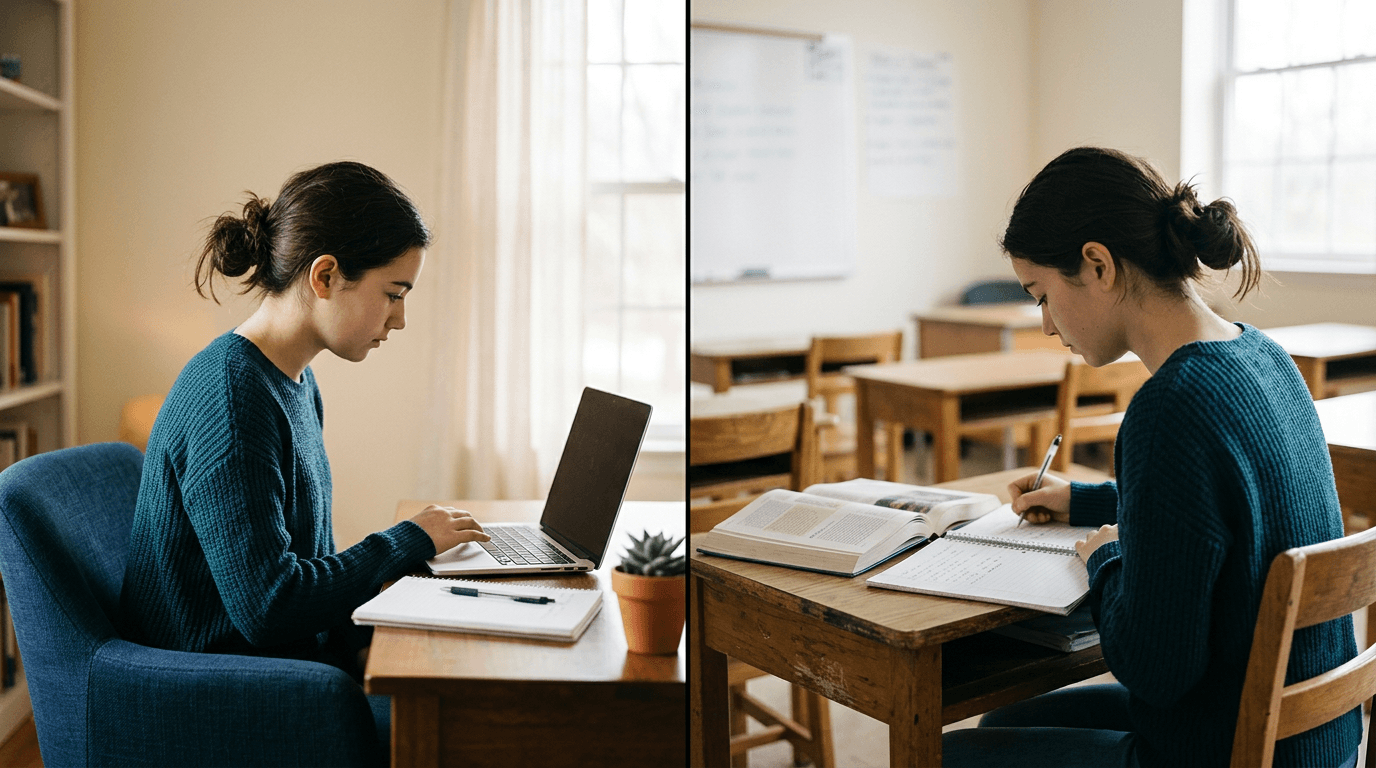
The conversation about online versus in-person tutoring is now, in many respects, an established debate. In the years since the pandemic accelerated the adoption of online learning, a meaningful body of evidence and practical experience has accumulated. The answer is not that one format is categorically better than the other, but that each has genuine strengths and specific failure modes, and knowing which applies to your student's situation is the relevant question.
This article sets out what the research supports, what each format does particularly well, where each tends to fall short, and how to make an informed decision for a student preparing for IGCSE or A-Level examinations.
What the evidence says about 1:1 tuition
The Education Endowment Foundation's Teaching and Learning Toolkit summarises the research evidence on approaches to raising attainment in schools. Its review of one-to-one tuition, based on 123 studies, finds that it is very effective on average, providing approximately five additional months of progress (Education Endowment Foundation, 2021).
What the review says about structure matters for the online versus in-person debate. Tuition is more likely to make an impact when it is additional to, and explicitly linked with, normal lessons, when sessions are short and regular, and when progress is monitored. Programmes that use teaching assistants or volunteers may achieve less than those that use experienced and specifically trained teachers. On format, the EEF reports that studies involving digital technology show broadly similar effects. Neither format inherently produces those conditions. The structure, the tutor's expertise, and the alignment of the programme to the student's specific curriculum are what a family should look at first.
Effective 1:1 support is characterised by diagnostic baselines, regular progress reviews, and targeted feedback aligned to examination criteria. These features are replicable online and in person.
What online tutoring does better
For most IGCSE and A-Level students, particularly those in the final one to two years of secondary education, online one-to-one tutoring offers structural advantages that are difficult to replicate in person.
Access to subject specialists
This is the single most significant advantage of online provision. A student in Edinburgh who needs an IB Mathematics: Analysis and Approaches HL tutor with examiner experience is not restricted to the available pool of tutors within commuting distance. Online tutoring makes the matching of student to specialist possible regardless of geography. For families in international schools, this is not a marginal benefit. It is frequently the only way to access appropriately qualified support.
Session recording
Online delivery makes session recording possible in a way that in-person tutoring does not, and providers treat it differently. Some release recordings to families for revision. Others, Sophyra Tutors included, record every session for safeguarding and dispute-resolution purposes only: recordings are stored securely, access is restricted to authorised administrators, and they are not released to tutors, students or parents. Families comparing providers should ask which model applies, because the two serve different purposes.
Scheduling flexibility
Online sessions require no travel time for either party. For students managing a demanding school timetable alongside extracurricular commitments, this makes it practically easier to fit regular sessions into the week. Consistency of frequency is, according to the EEF evidence base, one of the structural features of effective tutoring programmes.
A shared digital workspace
Effective online tutoring platforms provide shared whiteboards, collaborative document editing, and the ability to annotate past papers in real time. For subjects like Mathematics, Chemistry, and Physics, working through problem sets together on a shared screen can be at least as effective as a physical whiteboard, and has the added advantage that the student retains a digital copy of the worked examples.
Interested in structured online tutoring from subject specialists matched to your student's board and level? Book a free Sophyra consultation. We will identify the right tutor and the right programme.
What in-person tutoring does better
In-person tutoring is not a lesser option. For specific situations, it has genuine advantages.
Younger learners and students who struggle with screens
For students in Key Stage 3 (roughly ages 11 to 14) or younger, physical presence and the tactile elements of in-person learning, writing on paper, using physical manipulatives, maintaining focus without the visual complexity of a screen, can make a meaningful difference to engagement. Younger learners who have limited experience of structured online learning may also find it harder to maintain the focused attention that effective online sessions require.
Students with specific focus or attention difficulties
Some students find the online environment harder to manage if they are prone to distraction or if they have attentional difficulties that make self-regulation in front of a screen more demanding. In-person sessions provide a physical space that is clearly demarcated as learning time, with fewer potential distractions and a tutor who can observe and respond to shifts in focus more naturally.
Practical and laboratory components
For GCSE and IGCSE Sciences that include practical examinations or practical skills assessments, an in-person tutor with access to appropriate materials can offer hands-on support that online tutoring cannot replicate. This is a narrower advantage, most IGCSE practical assessment has an alternative-to-practical paper, but it is a real one for students who have limited school access to laboratory settings.
Hybrid models
A number of families find that a hybrid approach, primarily online, with occasional in-person sessions for specific tasks, provides the best of both formats. An example would be a student who works with an online specialist tutor for the bulk of their subject preparation but meets an in-person academic mentor for study-skills support, organisation, and longer writing sessions where a physical environment is preferred.
This model requires clear coordination between whoever is providing each type of support, and it works best when both parties are aware of the student's full programme.
What makes online tuition fail
Online tutoring, like any educational intervention, can fail. The most common failure modes are worth naming clearly.
Poor platform choice. A video call on a consumer tool without a shared digital workspace, collaborative annotation, or reliable connectivity is not an appropriate environment for academic tutoring. The platform matters. If a session involves a student holding a textbook up to a camera, the setup is wrong.
An unstructured programme. Ad hoc tutoring, where sessions respond to whatever the student has been set for homework that week, is the least effective form of 1:1 support. Without diagnostic assessment, defined goals, and regular review points, there is no mechanism for monitoring whether the student is actually making progress.
A tutor without subject or board specialism. A generalist tutor working across five subjects with students on multiple exam boards is unlikely to bring the depth of curriculum knowledge that effective examination preparation requires. Board knowledge and subject depth matter, as we discuss in our piece on choosing between exam boards.
No communication with the family. Parents should receive regular updates on progress, not just an invoice. Effective tutoring services provide feedback loops that help families understand what is being worked on, what progress has been made, and what the next priorities are.
How to set up a productive home study space for online tuition
The physical environment in which a student takes online sessions matters more than many families realise. A few practical considerations:
- A fixed, quiet location. Consistency of environment supports concentration. A student who takes sessions from the kitchen table one week and their bedroom the next has to re-establish focus each time.
- Good lighting, facing the screen. Back-lit faces (a student sitting in front of a window) make it harder for a tutor to read engagement and attentiveness.
- A reliable internet connection, preferably wired. Interruptions from a dropping connection disrupt the flow of explanation and waste session time.
- Screen size and viewing comfort. Viewing a shared whiteboard on a small phone screen is not equivalent to viewing it on a laptop or monitor. Where possible, use the largest screen available.
- Notifications silenced. This applies to the student's device and to any other devices in the room.
These are small details, but they compound across a full programme of sessions. The conditions around learning, not just the content of the sessions, shape how effectively students consolidate what they are taught.
Sophyra's online sessions are conducted on a platform with shared whiteboard functionality and collaborative annotation. Our approach page sets out how sessions are structured, and the subjects page explains how the programme is tailored to each specification.
Sophyra Tutors teaches one to one online, with a subject specialist matched to the student's specification and exam board. Book your free Sophyra consultation and we will recommend the right tutor and programme for your student.
Frequently asked questions
Is there evidence that online tutoring is as effective as in-person?
The Education Endowment Foundation's review of one-to-one tuition reports that studies involving digital technology show broadly similar effects to the rest of the evidence. It does not compare online and in-person tuition for IGCSE or A-Level students directly. The practical advantage of online provision is a different one: it allows a student to be matched with a subject specialist regardless of geography.
At what age is in-person tutoring preferable?
For students under the age of twelve, or those who find the online environment difficult to focus within, in-person sessions often work better. For IGCSE and A-Level students (typically aged 14 to 18), online provision is generally effective when the platform and tutor quality are appropriate.
What platform does Sophyra use for online sessions?
Sophyra uses our online classroom, a professional online tutoring environment with shared whiteboard and document annotation capability, not a standard consumer video call tool.
Can sessions be recorded for later review?
It varies by provider. At Sophyra Tutors every session is recorded, but recordings are held securely for safeguarding and dispute resolution rather than issued to families for revision. Ask any provider you are considering which of the two models it operates.
How many sessions per week is typical for IGCSE or A-Level preparation?
The EEF's review of one-to-one tuition in schools finds that short, regular sessions (about 30 minutes, three to five times a week) over a set period of up to ten weeks appear to give the optimum impact. The Sutton Trust advises schools that a tutoring course should ideally be made up of frequent sessions of up to an hour, over six to twelve weeks. At Sophyra Tutors, lessons last 60 minutes and run once or twice a week across a ten-week term. The right frequency depends on the student's starting point, the time available before examinations, and the number of subjects being supported.
Research reference: EEF review of one-to-one tuition. The review concerns studied educational interventions; its average does not predict a Sophyra student’s result.
The session-frequency advice also draws on the Sutton Trust’s 2023 tutoring report.
An example online lesson sequence
This is an illustrative sequence, not a client result. A Chemistry student attempts an equilibrium question on a shared whiteboard, explains the reasoning, then compares it with the mark scheme. The tutor explains the missing idea before the student attempts a different question independently. The useful check is whether the explanation transfers to the new question. Sophyra Tutors provides its tuition online.